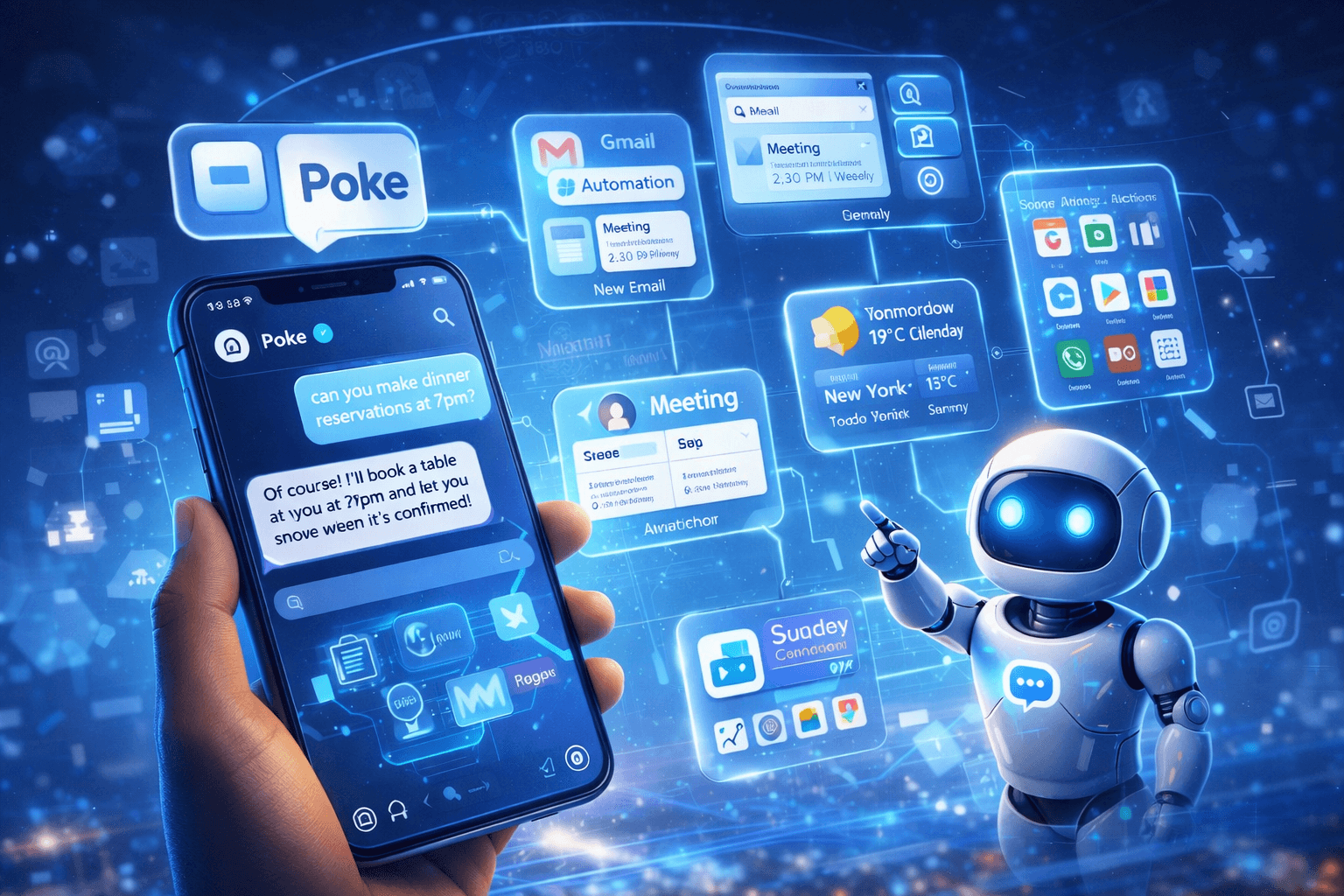

Poke is betting that the future of AI agents will not feel like using another app. It will feel like sending a text. This story explores why that matters, how the company is trying to turn automation into natural conversation, and why the real race in AI may now be shifting from raw intelligence to everyday usefulness, trust, and habit.
For a while, the AI industry has been obsessed with power. Bigger models. better benchmarks. longer context windows. faster answers. more capable systems. That part of the race is still very real, but another battle is starting to matter just as much. The next winner may be the company that makes AI feel natural enough for ordinary people to actually use every day. That is why the latest story around Poke matters. The company is not trying to sell AI as a futuristic dashboard full of controls and complexity. It is trying to make AI agents feel like something you use the same way you already use your phone, your messages, and your everyday conversations. According to the latest reporting, Poke can be accessed through iMessage, SMS, Telegram, and in some markets WhatsApp, with the promise that users can ask it to take action for them through a familiar text based interface.
That sounds simple on the surface, but it points to a much bigger shift. Most people do not want to learn a whole new operating system just to get some help with reminders, planning, or admin. They want something that fits into habits they already have. Poke’s pitch is built exactly around that idea. The company describes the product as an assistant that “lives in your texts,” and its documentation says users can chat naturally to manage email, schedule meetings, set reminders, search the web, and use integrations without needing to leave the messaging flow they already know.
The real story here is not just that another startup has entered the AI agent race. It is that the industry is starting to understand a hard truth. AI does not become mainstream just because it becomes more capable. It becomes mainstream when it becomes easier to reach, easier to trust, and easier to fit into daily life. The reporting says Poke launched publicly in March, aiming to give consumers a personal assistant that can take action on their behalf. It can help with daily planning, calendar management, health and fitness tracking, smart home control, photo editing, sports scores, medication reminders, and custom automations written in plain text. That is a very different pitch from the usual chatbot model, where users mostly ask questions or brainstorm ideas.
That difference matters because it moves AI from conversation into action. A chatbot can be impressive and still end up becoming something people only open occasionally. An agent that can watch for emails from your family, remind you about weather before you leave, manage your availability, or handle recurring little jobs is trying to become part of your routine. That is a much more ambitious goal. It also suggests that the future of AI may not belong only to the smartest system, but to the one that best disappears into normal life. That is an inference from Poke’s design and positioning, but it is a reasonable one given the company’s emphasis on messaging first automation and real world tasks.
What makes this interesting is how clearly the company is drawing a line between itself and traditional AI chat tools. The reporting frames the product as something you turn to when you want to get something done quickly or automate a task, rather than when you simply want answers or research. That may sound subtle, but it is actually a major product distinction. For the past two years, much of the consumer AI market has revolved around text generation, summarisation, search, and creative help. Poke is pushing harder into the assistant category, where AI is expected to act, not just respond.
The company’s own materials reinforce that. Its docs say it can help users read and draft emails, schedule meetings, set reminders, search the internet, and extend capabilities through integrations. Its site highlights connections with tools and services such as Gmail, Google Calendar, Outlook, Notion, GitHub, Todoist, Vercel, Linear, Ramp, Sentry, Supabase, and Webflow, while its FAQ says it supports full Gmail and Outlook inboxes, calendars, and contact sync, with additional integrations and even custom integrations through MCP.
That is where the bigger platform play begins to show. Poke is not just trying to be a clever text assistant. It is trying to become a conversational control layer over the apps and services people already use. If that approach works, the messaging thread becomes the interface, and the connected services become the muscles behind it. Users stop jumping between tools as often, because the agent handles the handoff. That does not mean the old app model disappears overnight, but it does show where the ambition is heading.
One of the smartest parts of this story is that Poke appears to be lowering the intimidation barrier around automation itself. The reporting says users can write their own automations in plain text and share them with friends. Over the last few weeks, users reportedly created thousands of recipes and automations, and the company plans to make them easier to discover through its recipes directory. It is also encouraging users to create shareable recipes by paying a small amount for signups driven through those recipes.
That is a clever move because automation has traditionally lived behind either technical tools or clunky setup experiences. For most people, the problem has never been that automation sounds bad. The problem is that it often feels like homework. You need to connect services, learn triggers, map actions, check settings, and hope nothing breaks. Poke is trying to wrap that complexity in conversation. Instead of opening a workflow builder, the promise is that you can simply describe what you want in normal language. If that holds up in practice, it could make automation feel less like software configuration and more like delegating a task to a helpful assistant. That interpretation is based on the product’s plain text recipe model and messaging first design.
There is also something fascinating about how the company is thinking about pricing. The report says it is free to start and then uses flexible pricing. During beta testing, users reportedly had to negotiate with the AI agent over what monthly price they would pay, with those numbers ranging from about $10 to $30. The company’s FAQ still reflects that unusual approach, saying users can keep chatting until they agree on a price.
That is a very online, very 2026 product decision. It turns pricing into part of the experience itself. Whether that feels playful or irritating will depend on the user, but it does fit the company’s broader attempt to make the assistant feel more conversational and less transactional. It also hints at a deeper uncertainty across consumer AI. Everyone wants scale, but nobody has fully solved how mainstream users want to pay for intelligent assistants that sit somewhere between software, service, and digital labour. Poke’s model may not become the standard, but it shows that the economics of consumer agents are still being invented in public.
Any AI assistant that wants access to your messages, calendar, contacts, and work tools runs straight into the trust problem. Convenience is attractive, but intimacy raises the stakes. Poke seems aware of that tension. Its FAQ says conversations are set to “Maximum Privacy” by default, meaning the company says it cannot see user chats in that mode and does not train on user data there. The company also says it supports inboxes, calendars, contacts, and a growing set of integrations, which makes its privacy posture more important, not less.
That does not automatically settle every concern, of course. Promises about privacy always have to survive real world scrutiny over time. But at a minimum, it shows the company understands that an action oriented assistant cannot win on convenience alone. It also has to make people comfortable handing over access to pieces of their digital life. In the consumer AI market, that may end up being one of the biggest dividing lines between products that get tried once and products that become habits. That conclusion is an inference, but it is strongly supported by the kind of access this product is asking users to provide.
The money behind the company also tells its own story. The report says the startup has 10 employees and has added another $10 million on top of a $15 million seed round from last year, putting it at a $300 million post money valuation. The investor list mentioned in the article includes major venture names as well as high profile founders and operators.
That does not prove the product will win, but it does show investors believe there is room for a serious consumer company built around agentic AI. And that may be the most important signal in this whole story. For a while, many people assumed agents would first become a business software phenomenon, living mostly inside enterprise workflows and specialist tools. Poke is a reminder that consumer AI is not standing still. There is still a major race to build the everyday assistant people actually keep around.
The FOMO Daily take is simple. Poke matters because it is chasing one of the hardest and most valuable ideas in AI right now: making agents feel normal. Not magical in a demo. Not impressive in a keynote. Normal. Familiar. Easy. Built into a habit people already have. That may end up being one of the strongest competitive advantages in the whole sector.
A lot of AI products still feel like destinations you have to visit. Poke is trying to feel like an extra layer inside life as it already happens. That is a smarter ambition than it might sound. If the future of AI really does become agent driven, the companies that win may not be the ones that ask users to learn a whole new behaviour. They may be the ones that quietly slip into behaviours people already repeat every day, like texting, checking messages, and asking for help in the middle of everything else. That is why this story is worth watching
-3-300x200.png&w=3840&q=75)
OpenAI’s cybersecurity push shows crypto why waiting for the hack is no longer enough
1 min read · 12 May 2026
-300x200.png&w=3840&q=75)
AI terms are no longer tech jargon they are becoming everyday survival language
1 min read · 9 May 2026

Wispr Flow’s India bet shows voice AI is moving beyond English-first tech
1 min read · 9 May 2026
-300x200.png&w=3840&q=75)
The front desk is becoming software, and AI is taking the first call
1 min read · 8 May 2026
-300x200.png&w=3840&q=75)
GPT-5.5 Instant shows the next AI race is about trust at everyday speed
1 min read · 6 May 2026
-4-300x200.png&w=3840&q=75)
AI is not just taking jobs or making jobs, it is rebuilding work itself
1 min read · 4 May 2026

AI Agents Are About To Get A CFO
1 min read · 1 May 2026
-3-300x200.png&w=3840&q=75)
Robots need better manners before they fill our shared spaces
1 min read · 30 Apr 2026

Crypto is facing an attention problem now
1 min read · 30 Apr 2026
-2-300x200.png&w=3840&q=75)
SoftBank is turning AI infrastructure into a robotics play
1 min read · 29 Apr 2026